Spinal conditions in children — therapy and building independence
The spinal cord is the link between brain and body. When it is affected, your child needs specialised support — and a team that understands how it all connects. At HOME4MOTION Kids that is exactly what we are.
When the spinal cord is affected — what that means for your child
Spinal conditions affect the spinal cord and with it the central pathways for motor and sensory nerve conduction. They include malformations such as spina bifida, spinal muscular atrophy (SMA), inflammatory or degenerative myelopathies and spinal muscular atrophies. Clinically there are often difficulties with movement, sensation and autonomic functions such as bladder and bowel control, the extent depending on the site and severity of the lesion.
Children with spinal conditions (including SMA) often face challenges around mobility, control of the body and independence. Depending on severity, assistive devices, support or ongoing therapy may be needed. For many families it is about making an active life, as self-determined as possible, achievable despite physical limitations. Early, continuous therapy is decisive for mobility and independence.
What children with spinal conditions experience
Spinal conditions can affect posture, mobility and bodily functions, and may call for particular support in daily life.Cognition: hydrocephalus with MMC can affect cognitive development.
Pain: neuropathic pain is possible.
Altered sensation: body awareness changed or absent.
Bladder & bowel: neurogenic dysfunction is common.
Altered sensation and problems with circulation.
Poor trunk stability: the abdominal and back muscles cannot give enough support.
Everyday life: dressing, eating and school need more support.
With spina bifida the diagnosis is usually known before birth. With other spinal conditions parents often first notice weakness, uncoordinated movements or altered sensation in the legs.
Our therapy for Spinal conditions
Our therapy supports posture, mobility and functional development, so that children are supported as well as possible in everyday life.
Physiotherapy
The best possible mobility — walking, with a walking frame or by wheelchair. Standing practice, stretching programmes. Close collaboration with Neuro-orthopaedics.
More on physiotherapy →Occupational therapy
Transfers, wheelchair handling, self-care, the school day. Advice on assistive devices included.
More on occupational therapy →Speech and language therapy
Where hydrocephalus is also present — from orofacial therapy through to augmentative communication.
More on speech and language therapy →Neuro-orthopaedics
Gait analysis, surgical planning and provision of assistive devices with Dr Švehlík.
More on Neuro-orthopaedics →Intensive therapy
Intensivphasen sind besonders nach Operationen und in Wachstumsschüben wichtig, da sich Körperstatik und Biomechanik verändern. Ziel ist die Stabilisierung von Funktion und Mobilität sowie die Schulung von Eltern in Transfers, Lagerung und Versorgung.
Learn more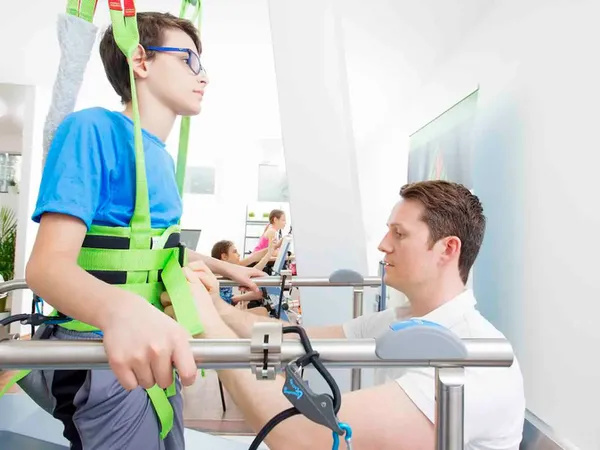
Using windows of neuroplasticity deliberately
Intensive phases matter particularly after surgery and during growth spurts, when the body’s posture and biomechanics change. The aim is to stabilise function and mobility, and to train parents in transfers, positioning and care.
Do you have questions about therapy for your child with a spinal condition?
Get to know us in a free information session — by phone, online or in person in Graz or Vienna.
One step changes everything
Read the stories of small fighters who take on every step with courage and delight in every bit of progress, however small. Real families, real journeys — and many moments that show how much is possible.
Children’s therapy in Graz & Vienna
HOME4MOTION Kids Graz
HOME4MOTION Kids Wien
Was Sie wissen möchten
Taking the next step together.
In the free initial consultation we look together at where your child is now and how we can best support them.