Cerebral palsy — therapy for children and adolescents
Every child with cerebral palsy is different. At HOME4MOTION Kids we support your child with physiotherapy, occupational therapy and speech and language therapy — playfully, individually and in line with current neurorehabilitation research.
Cerebral palsy — what parents should know
Cerebral palsy results from damage to the central nervous system in early childhood and leads to lasting differences in movement, posture and muscle tone. Spastic or hypotonic changes in the muscles are typical, along with limitations in motor control and coordination. Depending on severity, balance, fine motor skills and functional movement patterns may also be noticeably affected and require long-term therapeutic support.
Children with cerebral palsy often find sitting, grasping, walking or everyday movements challenging. Some movements take a great deal of effort or are only possible with support. Muscle tension, pain or tiring quickly can also shape the day. For children and families this often means building independence and taking part, step by step.
What children with cerebral palsy experience
Cerebral palsy presents differently in every child, depending on the region of the brain affected and the severity. These are the challenges that are typical:Foot position: an equinus foot, flatfoot with valgus or internal rotation of the hips make walking and standing considerably harder.
Body awareness: many children feel their body differently — altered sensation and changes in proprioception are common.
Spasticity & tiring: spastic movements take disproportionately much energy, so children tire faster than others their age.
Speech & swallowing: with tetraparesis, difficulties with speech (dysarthria), language and swallowing (dysphagia) often occur.
Contractures: without regular therapy, muscles and tendons can shorten and permanently change the position of joints.
Movement & motor skills: grasping, standing and walking are difficult — spasticity or too little muscle tone makes coordinated movement harder.
Fine motor skills: grasping, propping up, writing — hand function is often affected in hemiparesis and tetraparesis.
Trunk control: the abdominal and back muscles often cannot yet stabilise trunk and head enough — sitting and staying upright are tiring.
Everyday life & school: dressing, eating, writing, the way to school — many everyday tasks take more time and more support.
If you notice that your child favours one side of the body, is asymmetrical when crawling, or is not yet standing at 12 to 18 months, speak to your paediatrician. The earlier the diagnosis, the earlier therapy can begin.
Our therapy for Cerebral palsy
Therapy for cerebral palsy. Cerebral palsy needs more than one discipline. Our team works together every day so that your child gets the best possible support.
Physiotherapy
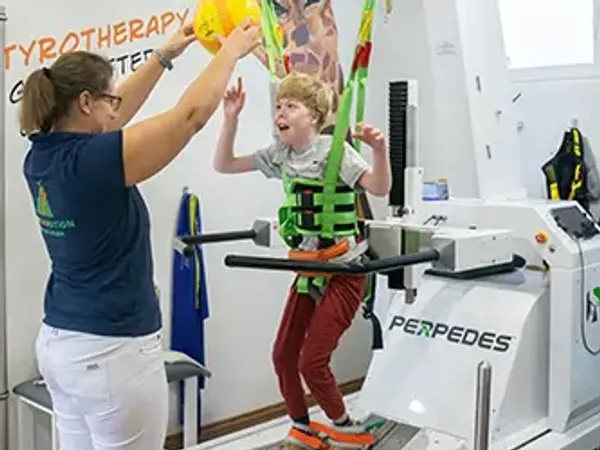
Improving gait pattern, balance, strength and coordination. Bobath and Forced Use as core concepts, complemented by robot-assisted gait therapy and sensory integration. Effective in hemiparesis, diparesis and tetraparesis.
More on physiotherapy →Occupational therapy
Training grasping, writing, dressing and eating. Ayres Sensory Integration. Advice on assistive devices (orthoses, writing aids, seating adjustments) including support with health insurance claims.
More on occupational therapy →Speech and language therapy
Building orofacial motor function, articulation, swallowing and language comprehension. Augmentative and alternative communication (AAC) where needed.
More on speech and language therapy →Neuro-orthopaedics
Dr Martin Švehlík coordinates the overall plan — gait analysis, planning of assistive devices, preparation for botulinum toxin and support around surgery. All in one place.
More on Neuro-orthopaedics →Intensive therapy
Intensivtherapie bei Infantile Zerebralparese (ICP) nutzt neuroplastische Zeitfenster nach Botulinumtoxin, Operationen und in Entwicklungssprüngen. Tägliche 3–5 Stunden Physio-, Ergo- und Logopädie mit Elterncoaching fördern nachhaltige funktionelle Verbesserungen.
Learn more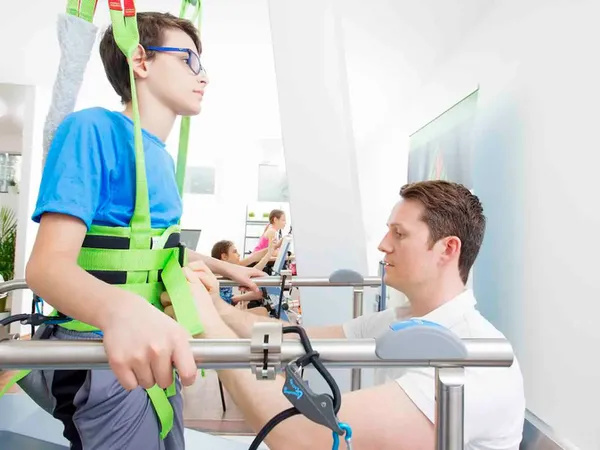
Using windows of neuroplasticity deliberately
Intensive therapy in cerebral palsy makes use of the windows of neuroplasticity after botulinum toxin, after surgery and during spurts in development. Three to five hours a day of physiotherapy, occupational therapy and speech and language therapy, with coaching for parents, support lasting functional improvement.
Do you have questions about therapy for your child with cerebral palsy?
Get to know us in a free information session — by phone, online or in person in Graz or Vienna.
One step changes everything
Read the stories of small fighters who take on every step with courage and delight in every bit of progress, however small. Real families, real journeys — and many moments that show how much is possible.
Children’s therapy in Graz & Vienna
HOME4MOTION Kids Graz
HOME4MOTION Kids Wien
Was Sie wissen möchten
Taking the next step together.
In the free initial consultation we look together at where your child is now and how we can best support them.