Muscular conditions in children — therapy and everyday support
Muscular conditions make everyday life a daily challenge for children and their families. At HOME4MOTION Kids we support your child with specialised therapists — for more mobility, strength and quality of life.
When muscles and nerves work differently — an overview
Muscular conditions (myopathies and neuromuscular conditions) primarily affect the muscle itself or the transmission between nerve and muscle. They include muscular dystrophies, spinal muscular atrophies and both hereditary and acquired neuropathies. Progressive muscle weakness, reduced stamina and limitations in motor function are characteristic, developing at different speeds depending on the particular condition.
With muscular conditions, tiring quickly, losing strength and finding movement restricted are often to the fore. Activities that others take for granted — climbing stairs, running or playing for longer — can be exhausting or only partly possible. Children often meet limits in daily life, while at the same time needing ways to stay active and in charge of their own choices.
What children with muscular conditions experience
Children with muscular conditions often have to deal with limited strength, tiring quickly and difficulties with movement sequences.Poor trunk stability: sitting and standing are limited.
Muscle weakness: sitting, standing and walking become harder.
Foot position differences and contractures are a risk without therapy.
Fine motor skills: hands and fingers cannot grasp or write precisely.
Swallowing may be affected where muscle tone is low.
Low muscle tone: too little muscle tension — grasping, sitting and walking are delayed.
Coordination: controlling movement and keeping balance are harder.
Parents often first notice that their child falls frequently, has difficulty climbing stairs, or has less stamina than others of the same age. With SMA it is often apparent early on that milestones are missing or that muscles do not seem as strong.
Our therapy for Muscular conditions
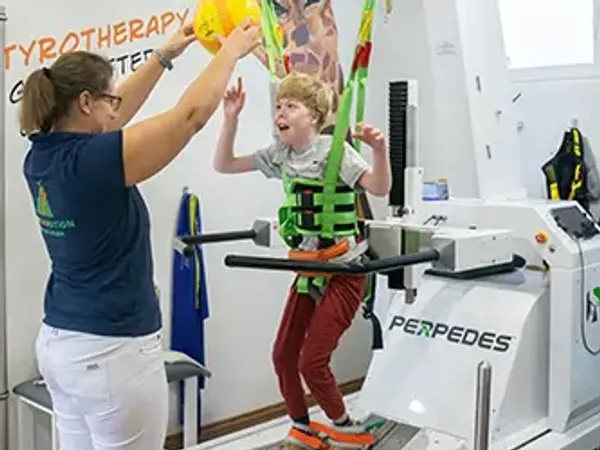
Through specialised therapy we build movement function, stamina and taking part in daily life, and support children over the long term.
Physiotherapy
Maintaining mobility, strengthening the muscles, preventing contractures, respiratory therapy.
More on physiotherapy →Occupational therapy
Optimising independence, wheelchairs, writing aids, support through the school day.
More on occupational therapy →Speech and language therapy
Safe swallowing, stamina in speaking, alternative communication.
More on speech and language therapy →Neuro-orthopaedics
Coordinating the provision of assistive devices and surgical planning.
More on Neuro-orthopaedics →Intensive therapy
Nach Beginn oder Wechsel einer SMA-Therapie unterstützt die Intensivtherapie die funktionelle Umsetzung neuer Kraftgewinne. Gleichzeitig werden Kontrakturen vorgebeugt und Eltern in Lagerung, Transfers und Heimprogrammen geschult.
Learn more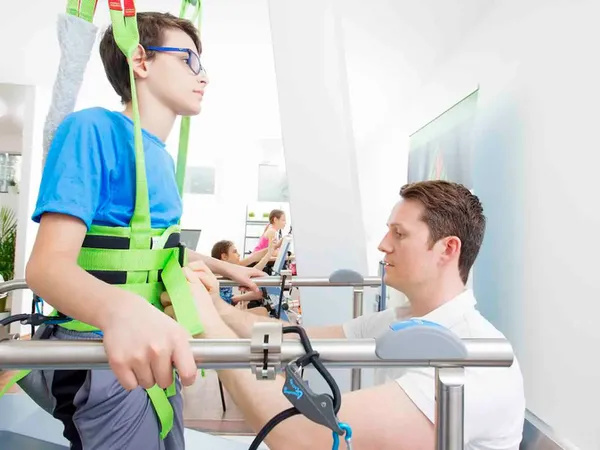
Using windows of neuroplasticity deliberately
After starting or changing a treatment for SMA, intensive therapy supports turning new gains in strength into real function. At the same time contractures are prevented and parents are trained in positioning, transfers and home programmes.
Do you have questions about therapy for your child with a muscular condition?
Get to know us in a free information session — by phone, online or in person in Graz or Vienna.
One step changes everything
Read the stories of small fighters who take on every step with courage and delight in every bit of progress, however small. Real families, real journeys — and many moments that show how much is possible.
Children’s therapy in Graz & Vienna
HOME4MOTION Kids Graz
HOME4MOTION Kids Wien
Was Sie wissen möchten
Taking the next step together.
In the free initial consultation we look together at where your child is now and how we can best support them.